
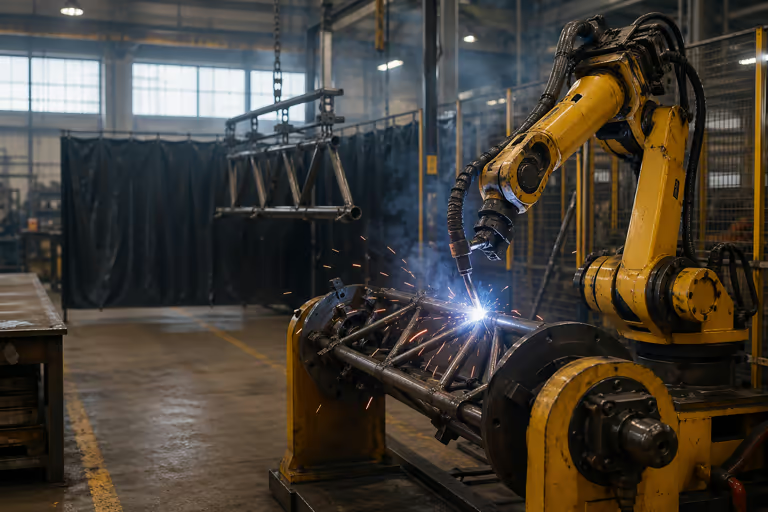
Robotic MIG/MAG Welding of Serial Metal Structures
The standard robotic cell for serial welding of metal profiles and steel trusses — 6-axis welding robot, MIG/MAG package, positioner, CE / SIL 2 fence.
Industries
- Structural steel and trusses
- MIG/MAG fabrication
- Serial production
Tech Stack
- 6-axis welding robot (6–12 kg payload, long reach)
- MIG/MAG torch EOAT with anti-collision clutch
- Rotary / tilting positioner (7th/8th axis)
- Zero-point fixturing for fast changeover
- CE / SIL 2 fence + welding curtain + fume extraction
Context and challenge
A fabrication shop producing metal profiles, frames and steel trusses in series — where welding the same assembly thousands of times a year by hand varies in quality and is hard to scale.
Weld-bead repeatability
Hand welding varies in geometry, bead height and spatter — across thousands of frames the variance compounds into visible and mechanical quality loss.
Serial volumes and changeover
The same profile thousands of times a year; fixture and program need to swap in minutes, not hours — otherwise throughput bleeds out in transitions.
Welder availability and health
Fumes, arc radiation, posture — a skilled hand welder is a scarce resource and cannot be scaled up quickly when orders grow.
CE / SIL 2 and fume extraction aren't optional
Fence, welding curtain, interlocks and local extraction are audit entry requirements (EN ISO 15012 for welding fumes).
Solution
A standard welding cell — 6-axis welding robot with MIG/MAG torch, a synchronised positioner, zero-point fixturing, and a CE / SIL 2 perimeter with extraction.
6-axis welding robot
FANUC M-10iD / ABB IRB 1520ID / KUKA KR 6 R1820 class — long reach, slim wrist, internal cable routing for the MIG/MAG torch.
MIG/MAG torch package + anti-collision clutch
Torch, wire, gas and spatter protection; the clutch protects the wrist on fixture contact and preserves calibration between cycles.
Synchronised positioner (7th/8th axis)
Rotary or tilt-rotary positioner, driven as the 7th/8th axis from the robot controller — access to difficult joints without reprogramming orientation.
Zero-point fixturing
Repeatable part placement in seconds; fast changeover across SKUs without re-teaching the robot and without manual alignment.
Weld-program library per SKU
Parameters (current, voltage, travel speed, weave) versioned on the HMI — the operator picks a SKU, not angles, on product change.
CE / SIL 2 fence + fume extraction
Welding curtain, interlocks and local extraction per EN ISO 15012 — the entry-level requirement of any modern welding shop.
Process, step by step
How a standard serial MIG/MAG welding cell is scoped — from a serial-production audit through commissioning under load.
Serial-production audit
Profile and assembly geometry, joint types (fillet / corner / butt), annual volume, current hand-weld takt and observed quality variance.
Robot, torch and positioner selection
Robot reach and duty cycle; torch class (wire Ø, material, gas); rotary vs tilt-rotary positioner — chosen to match the assembly geometry.
Fixturing and safety layout
Zero-point fixturing for every SKU family; CE / SIL 2 fence, welding curtain and fume extraction per EN ISO 15012; service zone around the cell.
Programming, commissioning and fine-tuning
Test coupons and macrographs; commissioning under load with an operator on shift; weld recipes for every SKU versioned on the HMI; tuning on a real batch.
2–3×
Typical throughput vs hand welding
±0.5 mm
Typical weld-bead repeatability
ISO 5817-B
Standard weld-quality level
CE / SIL 2
Standard safety rating
Related Case Studies
Palletising of Cement and Fertiliser Bags (up to 50 kg)
The standard robotic drop-in for heavy-duty palletising — heavy-duty robot, clamp gripper, IP54+ periphery, per-SKU recipes.
Read Case StudyRobotic Tending of Two CNC Lathes
One industrial robot tends two CNC lathes and routes finished parts onto shared conveyors — a single synchronised cycle.
Read Case Study“Serial welding is a repeatability problem before it's a speed problem — the robot wins on consistency, not because it's faster than a skilled welder.”

Have a similar application in mind?
Send us your requirements and we'll outline a concept proposal.