
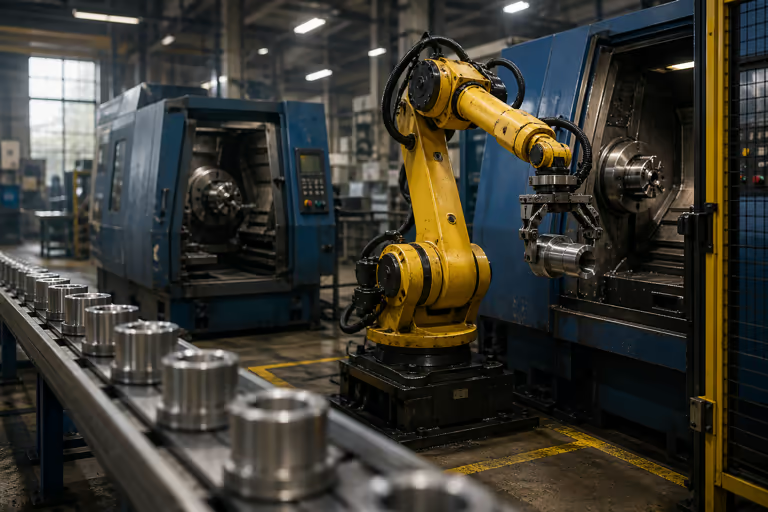
Robotic Tending of Two CNC Lathes
One industrial robot feeds two CNC lathes and routes finished parts onto shared off-load conveyors — load, unload and flow in a single synchronised cycle.
Industries
- Machining
- Metal components
- Automotive suppliers
Tech Stack
- 6-axis industrial robot
- Dual-lathe interface (I/O + door handshake)
- Off-load conveyors
- Safety perimeter
- Central PLC + HMI
Context and challenge
Manual load/unload of CNC lathes bleeds spindle time and loads up the operator — especially when a single cell pairs two machines.
Manual load/unload is the bottleneck
Every cycle bleeds spindle time while the operator loads and unloads by hand.
One operator, two lathes
Juggling between machines drives cycle-time variance and missed handoffs.
Unsynchronised off-load
Finished parts pile up or block the next station when there is no automated removal.
Need for predictable flow
Downstream stations only run stably on an even, predictable cadence.
Solution
A cell with one robot serving both lathes plus shared off-load conveyors — interfaces, safety and logic unified into a single installation.
Single industrial robot
6-axis manipulator with the reach for both lathes, without rearranging the machines on the floor.
Dual-lathe interface
I/O synchronisation and door handshake — eliminates collisions during door cycles.
Purpose-built gripper
End-of-arm tooling engineered for the actual part geometry — secure grip on both lathes.
Shared off-load conveyors
Receive finished parts and decouple cycle-time variance from downstream stations.
Safety perimeter
Fencing, light curtains and interlocks around the twin cell — safe stop on any incursion.
Central PLC + HMI
Synchronises both spindle cycles, the robot motion and the off-load in one logic, driven from a single screen.
How the cycle runs
One uninterrupted cycle — while one lathe is cutting, the robot tends the other.
Ready
The robot sits at home while both lathes are in cut.
Door-open handshake
The PLC signals lathe-1 cycle complete; the robot moves in and the door opens.
Unload and load
The robot removes the finished part, stages raw stock, closes the door and starts the next cycle.
Off-load
The finished part is placed on the shared conveyor; the robot is already heading to lathe-2.
Continuous rotation
The same cycle plays on lathe-2 while lathe-1 is cutting — and keeps playing, hands-free.
2:1
Lathes served per robot
≈2×
Typical throughput across both lathes
24/7
Unattended operation capable
−60%
Typical operator tending load
Related Case Studies
Automated Bin Picking of Metal Rings
3D vision and a FANUC robot lift metal rings from bulk bins and feed the next machine in a precise, continuous flow.
Read Case StudyRobotic Loading of Rubber Blanks into a Vulcanising Press
A COMAU robot with a Gimatic gripper feeds rubber blanks from multi-level racks into a vulcanising press — millimetre-precise, hands-free.
Read Case Study“When one robot owns the load, the unload and the flow, both spindles simply keep cutting.”

Have a similar application in mind?
Send us your requirements and we'll outline a concept proposal.