
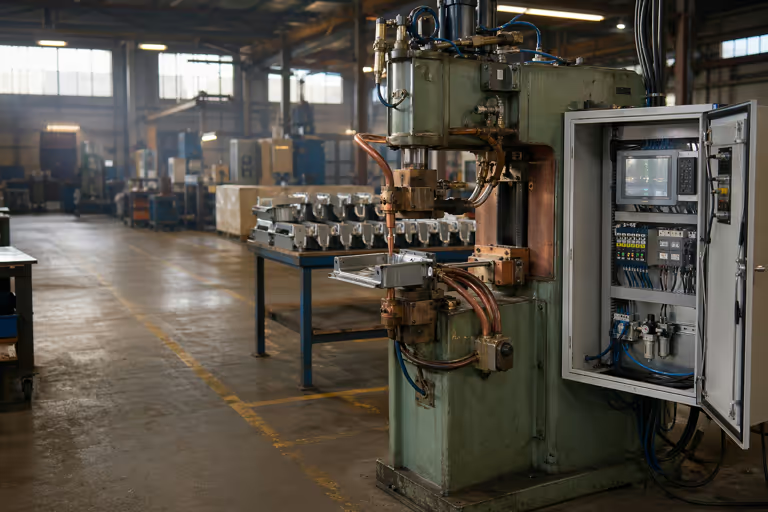
Control Retrofit of a Spot-Welding Machine
The same S7-1200 / TIA Portal playbook as the oven and injection-moulder retrofits — tuned here with a weld timer, current transducer, and pressure sensor, plus I/O prepared for a welding robot or cobot feeder later.
Industries
- Sheet-metal fabrication
- Appliance manufacturing
- Automotive suppliers
Tech Stack
- Siemens S7-1200 (Gen 2, 24 V DC)
- Weintek HMI over Profinet
- Weld timer + current transducer
- Pneumatic gun + pressure sensor
- Robot / cobot-ready I/O
Context and challenge
A spot-welding machine with sound mechanics and a healthy pneumatic gun, but running on an original 1990s controller — no per-weld data, no recipes, no interface to a robot.
1990s controls
The original controller is vendor-proprietary and out of support; spare parts live on eBay and in one operator's memory.
Welding without data
No log of current, time, or pressure per weld; scrap and rework are only discovered at a downstream operation or in inspection.
Parameters dialled per operator
Current and weld time are set manually per part; quality drifts with shift, fatigue, and operator interpretation.
No path to automation
The legacy controls cannot hand off to a modern welding robot or cobot feeder — automating the cell would require a second retrofit later.
Solution
The same migration playbook as the delivered oven retrofit and the 7d injection-moulder — new controller, modern HMI, rebuilt panel — with weld timer, current transducer, and pressure sensor as first-class signals and robot-ready I/O by design.
Siemens S7-1200 (Gen 2) + TIA Portal
The same modern platform as the other retrofits — one family of spares and one development environment across the plant.
Weld timer + current transducer
Weld current and duration captured per cycle — weld quality becomes observable data, not a feeling on the shop floor.
Pneumatic gun + pressure sensor
Electrode pressure becomes a first-class signal — trend curves per weld, not per shift.
Weintek HMI with trends and archive
Current, time, and pressure per weld in real time, archived by shift, part, and operator — root-cause analysis stops being guesswork.
Recipe library by material and thickness
Parameters are stored and selected, not dialled in on a potentiometer; changeover becomes a single touch in the HMI.
Robot-ready I/O + Profinet
Handshake lines and Profinet endpoints designed from day one — a welding robot or cobot feeder drops in later without a second retrofit.
How the retrofit runs
The same migration playbook as the other retrofits, with a welding-specific twist in the audit and in commissioning.
Audit and baseline welds
Inventory of original code, I/O, and wiring, plus a destructive-test baseline on sample welds — current, penetration, fracture — before any change is made.
Hardware upgrade
PLC, weld timer, current transducer, and pressure sensor in a rebuilt panel with 24 V DC control, cleanly separated from the power side.
Software, HMI, and recipes
Migrate the weld sequence to TIA Portal, configure trends and alarm history, and build the recipe library by material and thickness.
Commissioning + robot-ready handover
Validate weld quality against the baseline, train operators, and hand over the robot-integration interface as a documented contract for future automation.
Per-weld log
Current, time, and pressure archived per weld
10–15 yrs
Component availability horizon
Robot-ready
I/O ready for a welding robot or cobot
CE / SIL 2
Standard safety level
Related Case Studies
Control Retrofit of an Injection Moulding Machine
The same S7-200 → S7-1200 playbook as the oven retrofit — tuned for heater zones, hydraulics, and the SKU recipes of an injection moulder.
Read Case StudyCollaborative Spot-Welding Cell for Small-Batch Assemblies
The standard cobot cell for spot-welding small-batch sheet-metal — collaborative robot, compact spot gun, ISO/TS 15066 P&FL.
Read Case Study“Spot welding is 95% mechanics and 5% control — but those 5% decide whether every weld looks like the one before it.”

Have a similar application in mind?
Send us your requirements and we'll outline a concept proposal.