
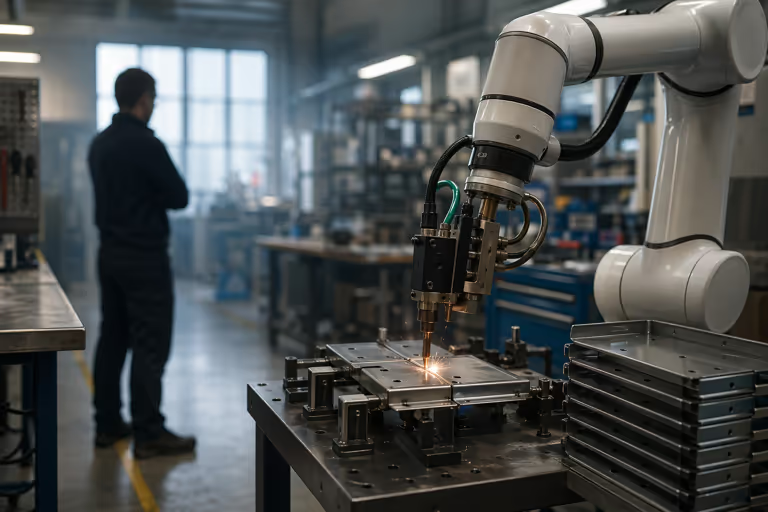
Collaborative Spot-Welding Cell for Small-Batch Assemblies
The standard cobot cell for spot-welding small-batch sheet-metal assemblies — collaborative robot, compact spot gun, ISO/TS 15066 P&FL and fast changeover.
Industries
- Sheet-metal fabrication
- Appliance assembly
- Electronics enclosures
Tech Stack
- Collaborative robot (10–20 kg payload)
- Compact spot-welding gun (C- or X-type, pneumatic/servo)
- Hand-guided programming (no teach pendant)
- ISO/TS 15066 power-and-force-limited
- Minimal perimeter + light curtain (per risk assessment)
Context and challenge
A sheet-metal shop running small batches and a high mix — where hand spot-welding is slow and inconsistent, and a full fenced industrial-robot cell is oversized for a single batch.
Small batches, high mix
50–500 units per SKU, often 5–20 different SKUs per week — hand welding is slow, and a fenced industrial-robot cell is oversized for batch volume.
Changeover over cycle time
The bottleneck isn't spot speed — it's how fast fixture and program swap between SKUs. Every cobot cycle gained is lost again in slow transitions.
Spot-weld repeatability
Position, force and time vary by hand on every cycle; a cobot with a servo-driven gun holds all three stable across SKUs and batches.
ISO/TS 15066 isn't optional
Collaborative-mode operation requires a risk assessment and a power-and-force-limited profile — it's not just a cobot without a fence. Real force and contact evaluation is required.
Solution
A standard cobot cell — a collaborative robot with a compact spot gun, hand-guided programming, fast-changeover fixturing and an ISO/TS 15066 P&FL profile with a minimal perimeter.
Collaborative robot
UR10e/UR20 / FANUC CRX-20iA / ABB GoFa / KUKA LBR iisy class — payload and reach for a compact spot gun plus onboard sensing for the P&FL profile.
Compact spot-welding gun
C- or X-type, pneumatic or servo-driven — the servo variant holds force and time under program control across SKUs, without mechanical re-adjustment.
Hand-guided programming
The operator guides the cobot arm through the spot pattern by hand; no teach pendant — a new SKU is taught in minutes, not hours.
Fast-changeover fixturing
Pogo pins or a small zero-point system — the fixture swaps without tools between small batches, with no re-teach on the cobot.
Spot-recipe library per SKU
Parameters (current, time, force) versioned on the HMI — the operator picks a SKU, not settings, when the product changes on the line.
ISO/TS 15066 + CE integration
Risk assessment, P&FL profile, safe-torque-off and a minimal perimeter with a light curtain where the risk assessment calls for it — the cobot is part of a legally certified cell.
Process, step by step
How a standard small-batch cobot spot-welding cell is scoped — from product-mix audit through commissioning under load.
Product-mix audit
Number of SKUs, batch sizes, typical spot patterns (4–20 spots per assembly), current hand-weld takt and observed quality variance.
Cobot and gun selection
Payload, reach and duty cycle of the cobot; gun type (C/X, pneumatic vs servo) chosen to match the sheet thickness and required force envelope.
Risk assessment and safety layout
ISO/TS 15066 P&FL profile, CE / SIL 2 controller, minimal perimeter and a light curtain where required — grounded in a real force-and-contact evaluation.
Teach-by-demonstration and recipe setup
The operator teaches spot patterns hand-guided; recipes for every SKU versioned on the HMI; commissioning under load with an operator on shift and tuning on a real batch.
200–500/shift
Typical spot throughput per shift
±0.2 mm
Typical spot-position repeatability
ISO/TS 15066
Standard collaborative-safety spec
CE / SIL 2
Standard safety rating
Related Case Studies
Robotic MIG/MAG Welding of Serial Metal Structures
The standard robotic cell for serial MIG/MAG welding of metal profiles — 6-axis welding robot, positioner, zero-point fixturing.
Read Case StudyAutomated Bin Picking of Metal Rings
3D vision and a FANUC robot lift metal rings from bulk bins and feed the next machine in a precise, continuous flow.
Read Case Study“A cobot spot-welding cell isn't a smaller industrial robot — it's a different economics: small batches, fast changeover, and an operator sharing the work instead of being locked out.”

Have a similar application in mind?
Send us your requirements and we'll outline a concept proposal.