
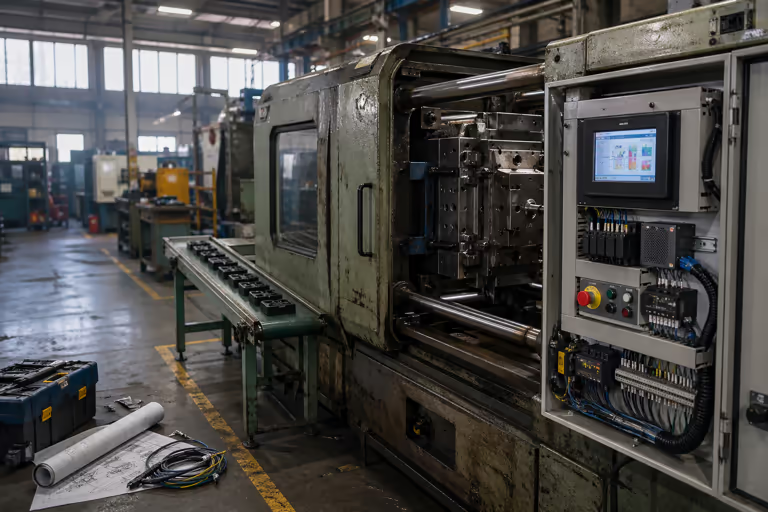
Control Retrofit of an Injection Moulding Machine
The same migration playbook as our polymerisation oven retrofit — Siemens S7-200 gives way to S7-1200 and a Weintek HMI — tuned here for the heater zones, hydraulics, and SKU recipes of an injection moulding machine.
Industries
- Plastics (injection moulding)
- Packaging (preforms, bottles)
- Consumer and technical parts
Tech Stack
- Siemens S7-1200 (Gen 2, 24 V DC)
- Weintek HMI over Profinet
- Heater zones + SSR (PWM)
- Hydraulic valves + pressure transducers
- SKU recipe manager
Context and challenge
An injection moulder whose mechanics are still sound, running on an obsolete original controller — S7-200, an early S5, or a vendor-proprietary board without active support. The mechanics hold; the electronics stop the line.
Controller at end of life
The original PLC is out of support; spare parts are rare and expensive, and downtime on a hot moulder is measured in money per hour.
Heater zones with no modern visibility
A multi-zone barrel heater and hot runner without trend logging or alarm history — drift is only noticed once the batch is already bad.
Hydraulics as a black box
The injection, clamp, and ejector pressure curves live inside the original vendor code — any change needs a factory engineer.
SKU recipes on paper and Excel
Per-product parameters do not live in the machine but in a binder or spreadsheet — SKU changeover is slow, manual, and error-prone.
Solution
A full control modernisation using the same playbook as the delivered oven retrofit — new controller, modern HMI, solid-state outputs, and a rebuilt panel — tuned to the specifics of an injection moulding machine.
Siemens S7-1200 (Gen 2) + TIA Portal
A modern platform with documented long-term component availability — a stable foundation for the next 10–15 years.
Heater zones with SSR + transistor outputs
PWM control of every barrel and hot-runner zone, proper per-zone PID — no mechanical wear and a tighter temperature regime.
Hydraulic control as data
Analog valves and pressure transducers turn the injection, clamp, and ejector curves into first-class, loggable signals.
Weintek HMI over Profinet
Real-time temperature and pressure trend curves, alarm history, SKU manager, and remote diagnostics — from day one.
Rebuilt panel
24 V DC control separated from the power side, modern wiring standards — safer and easier to diagnose under load.
SKU recipe library
Temperatures, times, and pressures stored per SKU in the HMI — product changeover becomes a one-touch action, not manual knob-twiddling.
How the retrofit runs
The classic migration playbook adapted for an injection moulder — from audit of the legacy system to handover with active remote diagnostics.
Audit of the legacy system
Inventory of the original PLC code, I/O, panel wiring, and failure history before any change is made.
Logic migration
Reverse-engineer the critical sequence — injection curve, clamp profile, ejector timing — and rewrite it in TIA Portal.
Rebuild and commissioning
New panel, new wiring, new I/O; bring the machine up on a real production part with fine-tuning of per-SKU temperatures and pressures.
Recipes, training, and remote
Migrate the SKU library into the HMI, train operators, and hand over with Profinet remote diagnostics enabled.
3–8 zones
Heater zones under independent PID
0
Mechanical relays in control loops
10–15 yrs
Component availability horizon
Profinet
Remote diagnostics over Ethernet
Related Services
Related Case Studies
Control System Retrofit of a Powder-Coating Oven
Siemens S7-200 retired in favour of an S7-1200 + Weintek stack: modern PID, recipe manager, and a 10–15-year parts runway.
Read Case StudyBin Picking of Injection-Moulded Plastic Parts
The same vision logic as the metal-rings cell — tuned for translucent, glossy, and dark plastics straight from the moulder.
Read Case Study“An injection moulder is mechanically sound for 20 years; its controls are obsolete in 8. A retrofit aligns the two lifetimes.”

Have a similar application in mind?
Send us your requirements and we'll outline a concept proposal.