
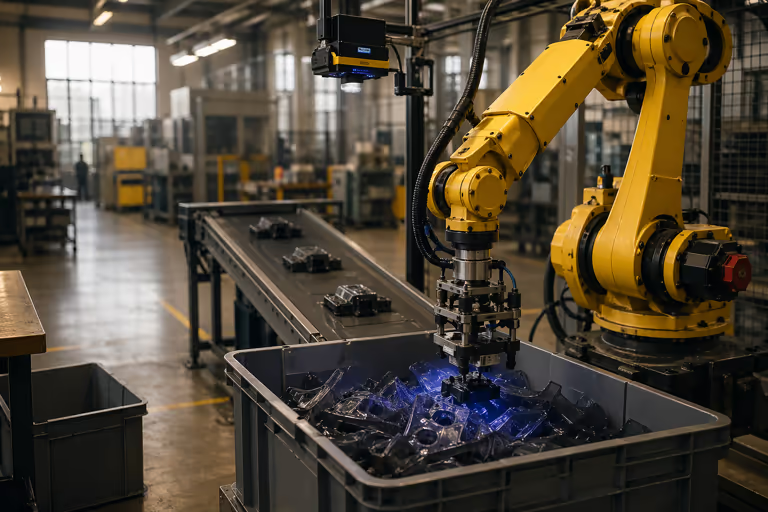
Bin Picking of Injection-Moulded Plastic Parts
The standard bin-picking vision cell, optically tuned for translucent, glossy, and dark plastic parts arriving chaotically from an injection moulder.
Industries
- Plastics (injection moulding)
- Consumer goods
- Packaging components
Tech Stack
- 6-axis industrial robot
- Polarised structured-light 3D vision
- Random-bin-picking algorithm
- Compliant vacuum / two-finger gripper
- Anti-tangle grasp planning
Context and challenge
Parts drop from an injection moulder into a loose bin — translucent, glossy, or black plastics that standard 3D cameras fail to image reliably.
Optics vs. translucent and dark plastic
Standard 3D cameras return noise, holes, or phantom surfaces on glossy, translucent, and black plastics — without the right illumination strategy the algorithm is blind.
Chaotic bin, straight off the moulder
Parts arrive in random orientations, often still warm, sometimes with residual release agent or grease — with no operator to tidy the bin before the camera sees it.
Flash, sprues, and tangling
Moulding flash, sprues, and hook-like features cause adjacent parts to lock together; a standard grasp planner lifts a tangled cluster, not a single part.
Wider tolerance downstream
Handoff is usually to a tray, conveyor, or secondary op (trimming, labelling, assembly) — not a CNC chuck — but repeatability is still non-negotiable.
Solution
A standard bin-picking cell with a vision strategy chosen for plastics and a gripper that does not mark or deform the part — under one integrated safety perimeter next to the moulder.
Polarised / structured-light 3D
Cross-polarisation suppresses glare on glossy and translucent plastics; blue-green structured-light LEDs give contrast on black and dark-coloured parts.
Random-bin-picking algorithm
Works on a chaotic pile, not a fixtured grid — returns a ranked list of grasp candidates with confidence scores, avoiding collisions with the bin walls.
Compliant gripping
Vacuum cup array or two-finger jaw with soft fingertips — picks without marking a clear surface and without deforming a thin-walled plastic part.
Anti-tangle grasp planning
The algorithm rejects grasps that would drag a neighbour; when needed, the robot performs a short shake motion to separate parts before picking the next one.
Regrasp / reorientation station
An intermediate pose where the part is flipped or reoriented for the specific downstream — tray, conveyor, trimming, labelling, or assembly.
Layout adjacent to the moulder
The cell fits next to or under the moulder dropoff — no added building footprint, no intermediate manual buffer between moulding and picking.
How the cell is built
How a standard plastics bin-picking cell is deployed — from an optical feasibility test on real parts to commissioning under load with a library of SKU recipes.
Optical feasibility test
We scan real parts in a real bin with candidate cameras (polarised, blue-green structured light); without a clean 3D cloud there is no point choosing a robot.
Vision and gripper sizing
Payload, reach, and cycle time against the hardest SKU; choice between vacuum, parallel jaws, or tool-change driven by part geometry and weight.
Safety integration
Fence, light curtains, and interlock between the moulder and the cell under one safety controller — CE / SIL 2 from day one, not bolted on at the end.
Commissioning + SKU recipes
Each SKU stored as a recipe in the HMI: vision parameters, gripper tool, downstream pose; ramp-up on a real batch with fine-tuning of confidence thresholds.
200–1000/h
Typical pick rate (parts/hour)
±0.5 mm
Typical placement tolerance at handoff
Polarised 3D
Vision stack for translucent and dark plastics
CE / SIL 2
Standard safety level
Related Case Studies
Automated Bin Picking of Metal Rings
3D vision and a FANUC robot lift metal rings from bulk bins and feed the next machine in a precise, continuous flow.
Read Case StudyIntegrated Robotic Cell for Bearings and Rotary Seals
An integrated robotic cell for bearings and rotary seals — deburring, vision inspection, greasing, assembly and off-load.
Read Case Study“Vision is 80% of the cost of a bin-picking cell — once it can see translucent plastic reliably, the robot part is ordinary.”

Have a similar application in mind?
Send us your requirements and we'll outline a concept proposal.