
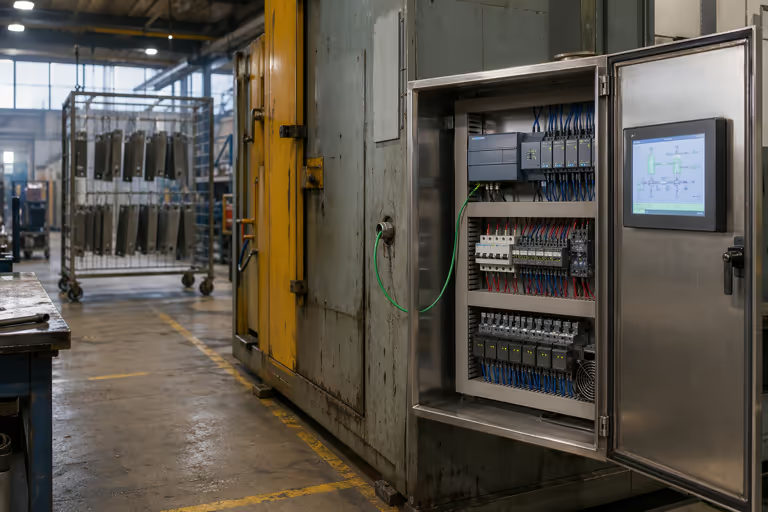
Control System Retrofit of a Powder-Coating Oven
Siemens S7-200 retires in favour of an S7-1200 (Gen 2) and a Weintek HMI over Profinet — modern PID, recipes, and a 10–15-year parts runway.
Industries
- Metal finishing
- Powder coating
- General manufacturing
Tech Stack
- Siemens S7-1200 (Gen 2, 24 V DC)
- Transistor outputs + SSR
- Weintek HMI over Profinet
- Rebuilt cabinet (control / power split)
- New PID + recipes + data logging
Context and challenge
A powder-coating curing oven running on a Siemens S7-200 with relay outputs and 220 V AC control — a controller that is both functionally and physically obsolete.
End-of-life controller
The Siemens S7-200 has been out of support for years — spare parts keep getting harder and more expensive to source.
Relay mechanical wear
Frequent switching under PID temperature control burns through relay outputs far faster than their rated service life.
220 V AC in the control loop
High voltage in the control circuits raises the risk to operators and maintenance — especially during live diagnostics.
Operating blind
The old HMI shows no temperature trends and no alarm archive — incidents only become visible after the fact.
Solution
A full controls modernisation — new controller, solid-state outputs, modern HMI, and a rebuilt cabinet delivered as a single project.
Siemens S7-1200 Gen 2
24 V DC power, the TIA Portal platform, and easy UPS integration — a stable base for the next 10–15 years.
Transistor outputs + SSR
PWM heater control — no mechanical wear, faster switching, and a much more precise PID regime.
Weintek HMI over Profinet
Live temperature trends, Data Logging, and an alarm archive — full visibility into the process at a glance.
Rebuilt cabinet
Control wiring separated from power, modernised termination standards — safer and easier to diagnose.
New PID algorithm
Precise temperature control — even curing across the part, with no over- or under-bake on the coating.
Recipe manager
Saved parameter sets for different parts and powder paints — one-touch switching, no manual retuning.
How the retrofit runs
A classic migration playbook — from auditing the legacy system to handing over a modern, observable control.
Audit
Inventory the existing S7-200 program, wiring, and failure history before changing anything.
Hardware upgrade
Swap the controller, replace relay outputs with transistor + SSR, and move control to 24 V DC.
Cabinet rebuild
Re-wire from scratch, separate control from power, and modernise terminations and labelling.
Software and HMI
Deploy Weintek, tune the new PID, author recipes and an alarm archive, enable Data Logging.
Handover
Commission under load, train operators, and hand over remote diagnostics via the Profinet port.
0
Relay mechanical failure points
±2 °C
Typical curing band with PID + SSR
10–15 yrs
Component availability runway
Profinet
Remote diagnostics over Ethernet
Related Case Studies
Robotic Tending of Two CNC Lathes
One industrial robot tends two CNC lathes and routes finished parts onto shared conveyors — a single synchronised cycle.
Read Case StudyRobotic Loading of Rubber Blanks into a Vulcanising Press
A COMAU robot with a Gimatic gripper feeds rubber blanks from multi-level racks into a vulcanising press — millimetre-precise, hands-free.
Read Case Study“A black-box relay panel becomes a tunable, traceable, future-proof system — same oven, completely different control.”

Have a similar application in mind?
Send us your requirements and we'll outline a concept proposal.