
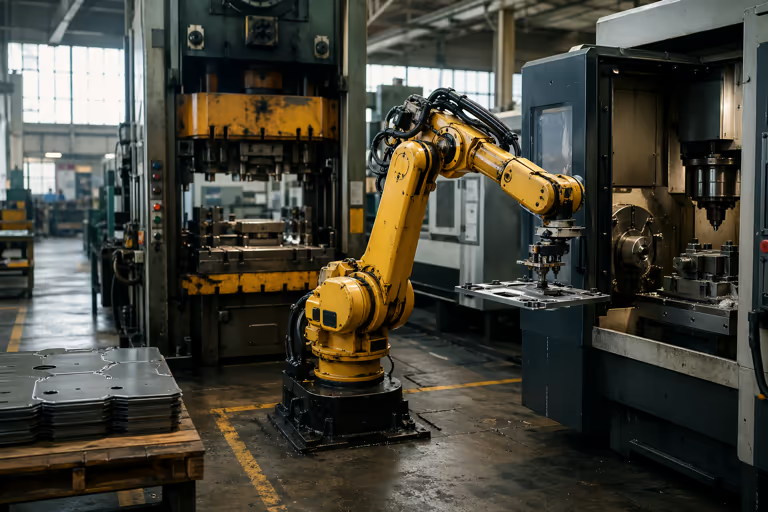
Robotic Press-to-CNC Load/Unload Integration
The standard robotic cell where a single 6-axis robot services a stamping press and a CNC in one cycle — loads, unloads, and transfers the part between the two machines with no manual buffer.
Industries
- Stamping and forming
- CNC machining
- Automotive suppliers
Tech Stack
- 6-axis industrial robot (10–25 kg payload)
- Custom gripper (blank + machined part)
- Zero-point workholding on the CNC
- Press interlocks + light curtains
- CE / SIL 2 fence + safety logic
Context and challenge
A production line where the part comes off a stamping press and continues into a CNC lathe or machining centre — today an operator stands between the two machines carrying, orienting and loading by hand.
Dual handoff in one cycle
The press output and the CNC input are two separate operations that have to stay in sync; the manual buffer between them is where the lost time hides.
The press hazard zone
A press is hot, heavy and cyclic; human access to the working zone is only safe under E-stop and isolated energy — not during normal production.
The CNC cycle sets the pace
The robot has to be ready to load inside the window the CNC is free; if it's seconds late the CNC idles and the gain from the dual handoff is lost.
Orientation into the workholding
It's not just pick-and-place — the part must enter the zero-point fixture in a repeatable orientation, or the CNC program throws tolerance off on cycle one.
Solution
A standard cell with a single 6-axis robot, a purpose-built gripper, zero-point workholding, press interlocks and unified safety logic across both machines — under one PLC/HMI.
6-axis industrial robot
FANUC M-20iD / ABB IRB 1600 / KUKA KR 20 class — payload and reach for a stamped blank and for the finished machined part within the same cycle.
Custom gripper
Vacuum or magnet for the blank off the press plus parallel jaws for the finished part — dual-tool or quick-change, chosen by layout and weight.
Press interlocks + E-stop integration
Safe-timer, energy isolation and a light curtain where needed; the robot enters the press zone only when the safety controller confirms the stroke is isolated.
Zero-point workholding + pre-orientation
A zero-point fixture on the CNC and, when needed, an intermediate pre-orientation station — repeatable position from part one to part n, with no manual tweak.
HMI recipe library per SKU
Press parameters, CNC program and gripper tool versioned per SKU on the HMI; the operator picks an SKU rather than setting up both machines independently.
CE / SIL 2 + unified safety logic
Fence, safety controller and interlocks that treat the press and the CNC as one safe unit — not two machines with two independent safety stories.
Process, step by step
How a standard press-to-CNC dual-handoff cell is scoped — from product-flow audit through commissioning under load.
Product-flow audit
Press cycle × CNC cycle × SKU mix — where the bottleneck actually sits, which machine sets the pace and how often the product changes; without this, robot sizing is a guess.
Robot and gripper selection
Payload and reach against the heaviest part; dual-tool vs gripper swap driven by the SKU mix and acceptable changeover between batches.
Safety integration
Press interlocks, CNC door safety, fence and light curtains unified under one safety controller — CE / SIL 2 from day one, not bolted on at the end.
Commissioning + HMI recipes
Every SKU in a library with press parameters, CNC program and gripper tool; commissioning under load with an operator on shift; tuning on a real batch.
200–600/shift
Typical throughput (parts/shift)
±0.1 mm
Typical blank placement accuracy
Press → CNC
Dual machine handoff with one robot
CE / SIL 2
Standard safety rating
Related Case Studies
Integrated Robotic Cell for Bearings and Rotary Seals
An integrated robotic cell for bearings and rotary seals — deburring, vision inspection, greasing, assembly and off-load.
Read Case StudyRobotic Tending of Two CNC Lathes
One industrial robot tends two CNC lathes and routes finished parts onto shared conveyors — a single synchronised cycle.
Read Case Study“A press and a CNC are two different machines with two different safety stories — the robot's job is to make them look like one.”

Have a similar application in mind?
Send us your requirements and we'll outline a concept proposal.