
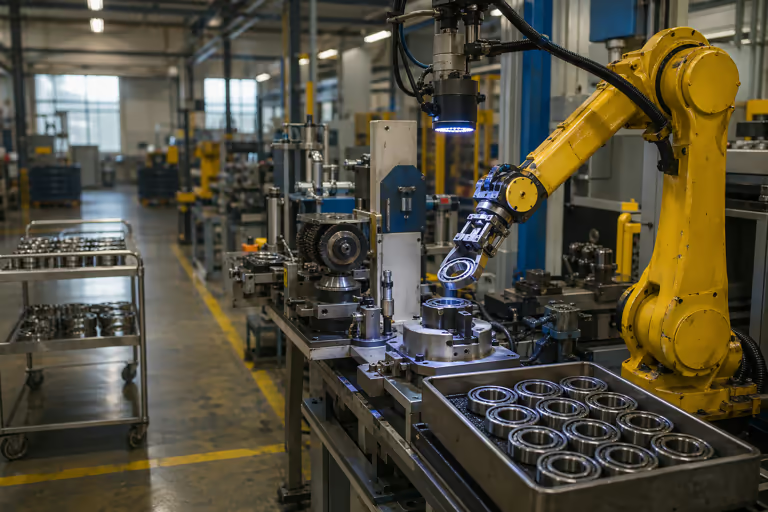
Integrated Robotic Cell for Bearings and Rotary Seals
The standard robotic cell that consolidates deburring, vision inspection, greasing, assembly and off-load into a single production unit.
Industries
- Bearings
- Rotary seals
- Precision components
Tech Stack
- 6-axis industrial robot (10–20 kg payload)
- Vision station (2D/3D camera + LED ring light)
- Deburring brush station + zero-point fixturing
- Greasing station with dosing
- CE / SIL 2 fence + safety light curtains
Context and challenge
A bearings and rotary-seal production line where deburring, inspection, greasing, assembly and off-load today live on separate workstations with manual handoffs between them.
5 stations in one cell
Deburring, inspection, greasing, assembly and off-load today are 5 separate workstations with manual handoffs between them; the synchronisation is lost there, not on the operations themselves.
Per-part inspection
On bearings and rotary seals every unit goes through visual and dimensional inspection; done by hand this scales linearly with headcount, a vision station does not.
Greasing with a precise dose
Grease quantity affects bearing life; an automated dosing station keeps grams per unit under program control — different from a manual judgment call between batches.
CE / SIL 2 isn't optional
Robot, moving periphery, lubricant and manual access for tray loading — the audit requires a fence, light curtains, safe-torque-off and interlocks from day one.
Solution
A standard integrated cell — 6-axis robot, vision station, deburring brush, greasing station with dosing, seal assembly and off-load to packaging, unified under one PLC/HMI.
6-axis industrial robot
FANUC M-20iD / ABB IRB 1600 / KUKA KR 20 class — payload and accuracy to manipulate a bearing and seal through all five stations.
Vision inspection station
2D/3D camera with LED ring light; checks for geometry, surface defects and seal presence; thresholds versioned per SKU on the HMI.
Deburring brush station
Removes excess material before assembly; a zero-point fixture holds the part in a repeatable position without manual alignment between SKUs.
Greasing station with dosing
Automated dose (grams per unit) under program control; no judgment call between batches, with traceability for every dose.
Seal assembly fixture
Press the rotary seal into the race with controlled force and position; the force curve is logged on the HMI for traceability and audit.
CE / SIL 2 integration + HMI recipe library
Fence, light curtains, safe-torque-off and interlocks; recipes per SKU (vision thresholds, grease dose, assembly force) versioned on the HMI.
Process, step by step
How a standard integrated bearing and rotary-seal cell is scoped — from product-family audit through commissioning under load.
Product-family audit
SKU families (diameter, width, seal type), tolerances, grease spec, current hand-work takt and observed defect rate between stations.
Station selection and layout
Number of stations by process (typically 5), sequence, robot class and reach; a 4-station variant when deburring is handled offline or upstream.
Fixturing, vision calibration and safety layout
Zero-point fixturing for every SKU family, vision thresholds set under the cell's lighting, CE / SIL 2 fence and light curtains per risk assessment.
Programming, commissioning and fine-tuning
Recipes per SKU (vision, grease dose, assembly force) on the HMI; commissioning under load with an operator on shift; tuning on a real batch.
1200–2400/shift
Typical throughput per shift
±0.05 mm
Typical vision-inspection repeatability
5 Stations
Consolidated into one cell
CE / SIL 2
Standard safety rating
Related Case Studies
Collaborative Spot-Welding Cell for Small-Batch Assemblies
The standard cobot cell for spot-welding small-batch sheet-metal — collaborative robot, compact spot gun, ISO/TS 15066 P&FL.
Read Case StudyAutomated Bin Picking of Metal Rings
3D vision and a FANUC robot lift metal rings from bulk bins and feed the next machine in a precise, continuous flow.
Read Case Study“An integrated bearing cell isn't five machines next to each other — it's one production unit where the robot owns the handoffs that people used to own.”

Have a similar application in mind?
Send us your requirements and we'll outline a concept proposal.