
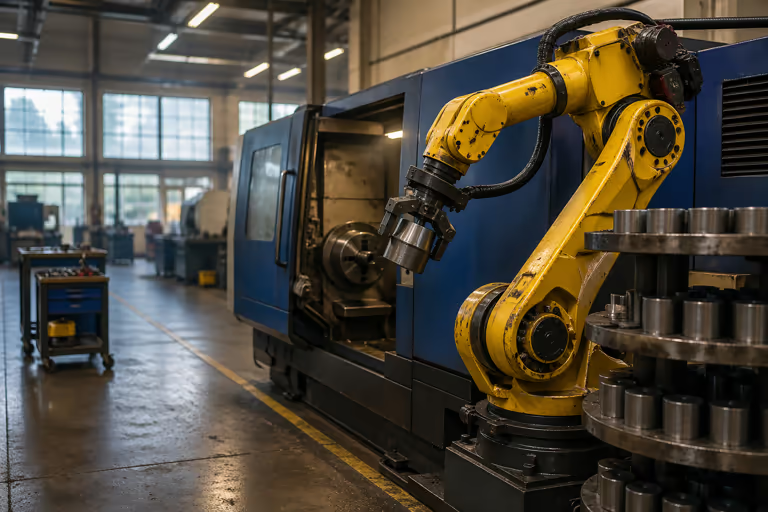
Single-CNC Tending with a Part Magazine
The standard cell with one 6-axis robot and a multi-tier part magazine — the spindle keeps cutting while the operator is on another machine or off-shift, with door + chuck handshake and unified CE / SIL 2 safety.
Industries
- Machining
- Job shops and small batches
- Metal components
Tech Stack
- 6-axis industrial robot (10–25 kg payload)
- Rotary / multi-tier part magazine
- Door + chuck handshake over Profinet
- Gripper for prismatic / turned blank
- CE / SIL 2 fence + safety logic
Context and challenge
A job shop with a single CNC lathe or machining centre running one shift — not because the machine can't do more, but because nobody stays to feed it at night or on the weekend.
One shift because of feeding
The CNC runs one shift because nobody stays to load it — the spindle is capable of more, the logistics around it are not.
The spindle waits on the operator, not the part
Between loads the spindle idles; across an 8-hour shift those idle seconds compound into a whole shift of lost capacity.
Night and weekend hours are out of reach
Lights-out operation needs a buffer of ready blanks that a human shelf does not provide and that a person cannot safely replenish during a running cycle.
SKU changeover is manual
Blank, program and gripper change together; without a recipe and a staged magazine, changeover costs more than it should.
Solution
A standard cell with one 6-axis robot, a rotary or multi-tier part magazine, door + chuck handshake and unified CE / SIL 2 safety — the magazine is refilled without stopping the cycle.
Single 6-axis industrial robot
FANUC M-20iD / ABB IRB 1600 / KUKA KR 20 class — payload and reach for a cylindrical or prismatic blank and for the finished part within the same cycle.
Rotary or multi-tier magazine
Capacity sized for a full lights-out window — one shift, a night, a weekend; rotary for turned blanks, multi-tier for prismatic.
Door + chuck handshake over Profinet
CNC door open/close and chuck clamp state exchanged as first-class signals — the robot never races the door or forces the chuck.
Gripper for the actual geometry
Parallel jaws or vacuum tuned to the blank and to the finished part, with enough authority for swarf-covered stock off the magazine.
HMI recipes per SKU
Blank geometry, CNC program reference and gripper tool versioned per SKU on the HMI; changeover becomes a pick-list, not a hand-setup.
CE / SIL 2 + refill-safe magazine
Safety controller, fence and a dedicated light curtain or door over the magazine refill zone — the operator tops up the magazine without stopping the cycle.
Process, step by step
How a standard magazine-fed tending cell is scoped — from shift and SKU-mix audit through commissioning against a real lights-out window.
Shift and SKU-mix audit
How long does lights-out need to last, how many SKUs are in rotation, and what is the longest uninterrupted cutting window a single magazine load must cover.
Magazine design + robot/gripper selection
Magazine capacity against the required window; robot payload and reach against the heaviest blank; gripper against the dirtiest SKU.
Safety integration
CNC door, robot perimeter and magazine refill zone under one safety controller — refilling during production, not during a stop.
Commissioning + HMI recipes
Every SKU with blank, program and gripper; commissioning under load with an operator on shift; tuning against a real lights-out window before handover.
Unattended hours
Typical unattended cutting window per magazine load
1:1
One robot, one CNC, one buffered feed
40–200 blanks
Typical magazine capacity
CE / SIL 2
Standard safety level
Related Case Studies
Robotic Tending of Two CNC Lathes
One industrial robot tends two CNC lathes and routes finished parts onto shared conveyors — a single synchronised cycle.
Read Case StudyRobotic Press-to-CNC Load/Unload Integration
One robot owns both handoffs — press output and CNC input — with zero-point workholding, press interlocks, and a safe perimeter.
Read Case Study“A CNC isn't waiting for the operator — it's waiting for the next blank. The magazine just keeps that blank an arm's length from the spindle.”

Have a similar application in mind?
Send us your requirements and we'll outline a concept proposal.