
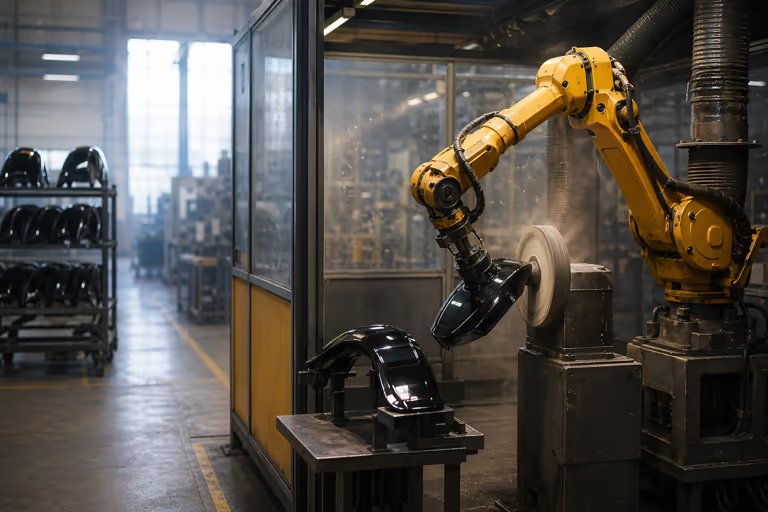
Robotic Polishing Cell for Plastic Parts
A robotic cell with a compliant force-control flange and a fixed wheel / belt station — surface quality becomes a recipe instead of a skill that leaves with the operator.
Industries
- Plastics (finishing operations)
- Consumer goods
- Automotive trim and interior
Tech Stack
- 6-axis industrial robot (10–25 kg payload)
- Compliant force-control flange
- Polishing wheel / belt station
- Enclosed cell with dust extraction and HEPA filters
- CE / SIL 2 fence + safety logic
Context and challenge
A finishing line for moulded plastic parts where polishing before packing and shipping rides on one person's skill — and changes tone with every new operator, every shift, and every batch.
Quality rides on one person
The finishing line depends on a single skilled polisher; training takes months, and output swings with shift, fatigue and turnover.
Manual polishing is physically punishing
Sustained vibration and awkward posture create real injury risk — which is why this role has high turnover and is hard to re-staff.
Curved surfaces separate the master from the novice
Flat faces are easy; curved, stepped and multi-face surfaces are where a novice polishes through or leaves visible lines.
Dust and compounds demand their own zone
Polishing compounds and fine dust need a dedicated extraction zone sized for the load — manual stations rarely get one at the right capacity.
Solution
An enclosed cell with a 6-axis robot, a compliant force-control flange and a fixed wheel / belt station — pressure becomes calibrated force instead of operator stamina; the dust stays inside, the operator stays outside.
6-axis industrial robot
FANUC M-20iD / ABB IRB 1600 / KUKA KR 20 class — reach and payload for the part plus the gripper across a full polishing path.
Compliant force-control flange
Calibrated pressing force replaces position as the primary control variable; geometry variance is absorbed by the flange instead of being translated into gouges or dull spots.
Fixed wheel / belt station
The tool is stationary and the part travels with the robot; for large parts the configuration is reversed — tool on the arm, part on the jig.
Path library per SKU
A 6-axis path with a force profile per SKU face; complex curves become a program, not a skill that leaves the company when the operator does.
Dust extraction + HEPA
Extraction sized per compound, HEPA filter on discharge; the operator stays outside the compound cloud instead of living inside it.
CE / SIL 2 + refill-safe cell
Door interlock and a safety controller; loading raw parts and unloading finished ones uses a refill zone that stops only the affected axis, not the whole cycle.
Process, step by step
How a standard plastics polishing cell is scoped — from a surface-roughness baseline through Ra validation on a real batch.
SKU audit + surface baseline
Measure actual roughness straight off the moulder and decide which SKU faces are cosmetic-critical vs structural-only; without that baseline the cell has nothing to validate against.
Robot, flange and wheel/belt selection
Compliance budget and cycle time against the worst face of the worst SKU; wheel vs belt is chosen by geometry — tight radii favour belt, flats favour wheel.
Path programming + dust containment
A 6-axis path per SKU face with a force profile; extraction sized per compound; a CE-compliant enclosure with an interlock on the refill door.
Commissioning + Ra validation
Validate surface quality against the baseline on a real batch, lock the recipes, and hand over with a single-operator runbook — load, unload, recipe swap.
Force-compliant
Calibrated pressing force per SKU face
Ra 0.1–0.4 µm
Typical surface roughness after polish
Dust-extracted
Enclosed cell with dust extraction and HEPA filters
CE / SIL 2
Standard safety level
Related Case Studies
Bin Picking of Injection-Moulded Plastic Parts
The same vision logic as the metal-rings cell — tuned for translucent, glossy, and dark plastics straight from the moulder.
Read Case StudyRobotic Loading of Rubber Blanks into a Vulcanising Press
A COMAU robot with a Gimatic gripper feeds rubber blanks from multi-level racks into a vulcanising press — millimetre-precise, hands-free.
Read Case Study“Polishing isn't about position — it's about force. A robot holds that force constant; a human operator loses it by the third part.”

Have a similar application in mind?
Send us your requirements and we'll outline a concept proposal.