
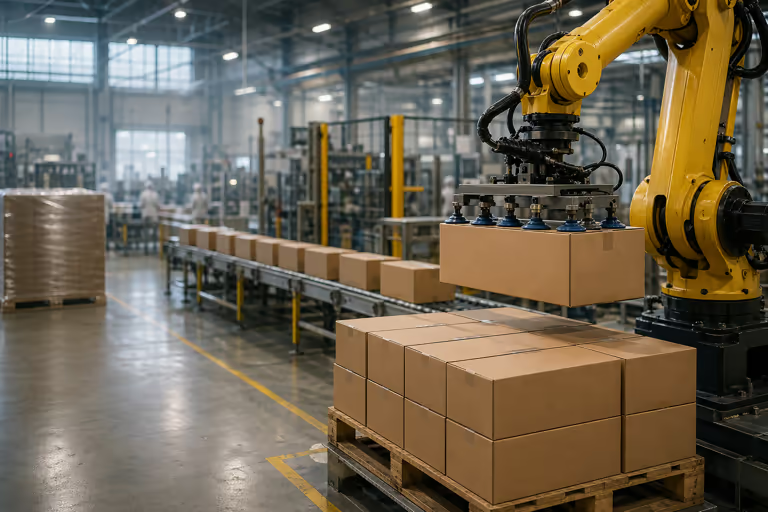
Robotic Palletising of Cartons and Stacks in Food & Beverage
The standard robotic drop-in at the end of a food-line — a 6-axis robot with a vacuum or clamp gripper, a dual-pallet FIFO layout, and CE / SIL 2 safety.
Industries
- Food & beverage
- End-of-line packaging
- Distribution and warehousing
Tech Stack
- 6-axis industrial robot (20–50 kg payload)
- Vacuum / clamp gripper — quick-change
- HMI recipes per SKU
- Dual-zone FIFO pallet layout
- CE / SIL 2 fence + light curtain
Context and challenge
End of line in a food & beverage plant — cartons and stacks come off the packaging machine and need to be palletised quickly, evenly, and without stopping production.
Manual load at end-of-shift
Cartons and stacks are palletised by operators — errors and fatigue climb in the last hours of the shift.
Many SKUs, many layer patterns
Every product and every pallet size wants its own layer recipe — a paper SOP and verbal instructions don't scale.
Pallet change-out without stopping
Full pallet out, empty in, conveyor still running — the line can't afford to stop while the pallet zone is serviced.
CE safety isn't optional
Fence, light curtain and interlocks are audit entry requirements, not an add-on line item at the end of the project.
Solution
A standard robotic cell built around four pillars — robot with gripper, HMI with per-SKU recipes, dual-zone FIFO layout, and a CE / SIL 2 perimeter.
6-axis industrial robot
Reach and payload matched to the heaviest SKU plus gripper — FANUC / ABB / KUKA class, programmed for long, consistent cycles.
Vacuum / clamp quick-change gripper
Tool for carton, stack or tray; swapped by the operator via HMI at product change — no engineer on site required.
HMI with layer recipes
Every SKU with its own pattern and pallet height — the operator picks from a list, no robot reprogramming involved.
Dual-zone FIFO pallet layout
While one pallet is being swapped out, the robot keeps stacking the other zone — no line stoppage for routine servicing.
CE / SIL 2 fence + light curtain
Perimeter with interlocks and a service zone — the entry-level requirement of any modern food & beverage plant.
PLC coordination with the line
Handshake with the downstream conveyor, label printer and barcode scanner — stop-and-resume scenarios built in.
Process, step by step
How a standard food-line palletising cell is scoped — from line audit through commissioning under load.
Line audit
SKU inventory, carton and pallet dimensions, throughput (cph), existing conveyor infrastructure — the base for robot and gripper selection.
Robot and gripper selection
Payload, reach and speed matched to the heaviest SKU and maximum pallet height; gripper type chosen per product format.
Safety and layout
Fence with two pallet-change gates, light curtain, interlocks and a service zone — all engineered to CE / SIL 2.
Integration and recipe setup
PLC to conveyor, printer and scanner; HMI with recipes for every SKU; commissioning under load with an operator on shift.
600–900/h
Typical carton throughput
−70%
Typical manual-labour reduction
CE / SIL 2
Standard safety rating
2-zone FIFO
Standard dual-pallet layout
Related Case Studies
Robotic Tending of Two CNC Lathes
One industrial robot tends two CNC lathes and routes finished parts onto shared conveyors — a single synchronised cycle.
Read Case StudyRobotic Loading of Rubber Blanks into a Vulcanising Press
A COMAU robot with a Gimatic gripper feeds rubber blanks from multi-level racks into a vulcanising press — millimetre-precise, hands-free.
Read Case Study“Palletising isn't just a robot with a gripper — it's the SKU recipes and the dual-zone FIFO layout that make the line stable.”

Have a similar application in mind?
Send us your requirements and we'll outline a concept proposal.