
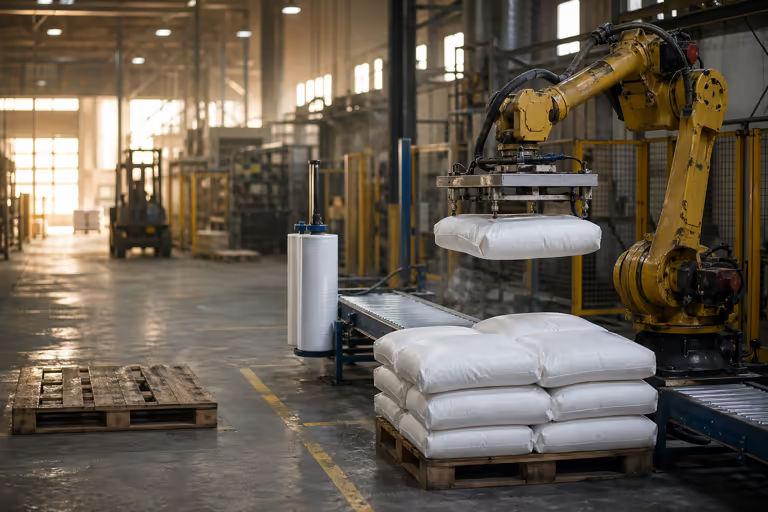
Heavy-Bag Palletising (Flour, up to 25 kg)
The standard robotic drop-in for heavy-bag palletising — a 6-axis heavy-duty robot, a clamp gripper, dust-ready peripherals, and CE / SIL 2 safety.
Industries
- Food & beverage
- Milling and agriculture
- End-of-line packaging
Tech Stack
- 6-axis heavy-duty robot (80–150 kg payload)
- Clamp / plate gripper for bags
- Dust-ready peripherals (IP-rated)
- HMI recipes per bag SKU
- CE / SIL 2 fence + light curtain
Context and challenge
A milling or food plant where 25 kg flour bags are palletised at the end of the line — heavy, dusty and ergonomically punishing work when done by hand.
Physical load and ergonomics
25 kg bags, thousands of times per shift — shoulders, backs and knees wear out; turnover and sick leave become part of the line's running cost.
Flour dust and safety
Flour dust is combustible (an ATEX consideration) and damages electronics, servo drives and encoders if the periphery isn't engineered for it.
Pallet change-out without stopping
Full pallet out, empty in, conveyor still running — the line can't afford to stop while the pallet zone is being serviced.
CE safety isn't optional
Fence, light curtain and interlocks are audit entry requirements, not an add-on line item at the end of the project.
Solution
A standard robotic cell built around four pillars — heavy-duty robot with clamp gripper, dust-ready peripherals, HMI with per-SKU recipes, and a CE / SIL 2 perimeter.
6-axis heavy-duty robot
Payload and reach for a 25 kg bag plus clamp gripper — FANUC M-410 / KUKA KR QUANTEC PA / ABB IRB 660 class, programmed for long, consistent cycles.
Clamp / plate gripper for bags
A specialised tool for irregular, compliant bags — vacuum-based grippers don't hold reliably when flour dust and paper packaging are in play.
Dust-ready peripherals
IP-rated servo drives, sealed encoders and filtered cabinet cooling; ATEX zoning around the pallet area when the flour class requires it.
HMI with layer recipes per SKU
Every SKU with its own pattern and pallet height — the operator picks from a list, no robot reprogramming on product change.
Dual-zone FIFO pallet layout
While one pallet is being swapped out, the robot keeps stacking the other zone — no line stoppage for routine servicing.
CE / SIL 2 fence + light curtain
Perimeter with interlocks and a service zone — the entry-level requirement of any modern milling or food & beverage line.
Process, step by step
How a standard heavy-bag palletising cell is scoped — from line audit through commissioning under load.
Line audit
Bag dimensions and weight, throughput (bph), pallet variants, flour-dust characteristics and existing conveyor infrastructure — the base for robot and gripper selection.
Robot and gripper selection
Payload class and reach matched to the bag plus gripper; clamp tooling chosen for the specific bag format; dust-rating on every component.
Safety, dust and layout
CE / SIL 2 fence with pallet-change gates, light curtain, IP-rated peripherals — with ATEX zoning and a service zone where the flour class requires it.
Integration and recipe setup
PLC to conveyor, label printer and scanner; HMI with recipes for every SKU; commissioning under load with an operator on shift and fine-tuning.
400–600/h
Typical bag throughput
up to 25 kg
Typical bag payload per pick
CE / SIL 2
Standard safety rating
−70%
Typical manual-labour reduction
Related Case Studies
Robotic Palletising of Cartons and Stacks in Food & Beverage
The standard robotic drop-in at the end of a food-line — 6-axis robot, quick-change gripper, per-SKU layer recipes, dual-pallet FIFO.
Read Case StudyRobotic Loading of Rubber Blanks into a Vulcanising Press
A COMAU robot with a Gimatic gripper feeds rubber blanks from multi-level racks into a vulcanising press — millimetre-precise, hands-free.
Read Case Study“Heavy-bag palletising isn't just a bigger robot — the weight, dust, and ergonomics demand a different class of tooling and peripherals.”

Have a similar application in mind?
Send us your requirements and we'll outline a concept proposal.